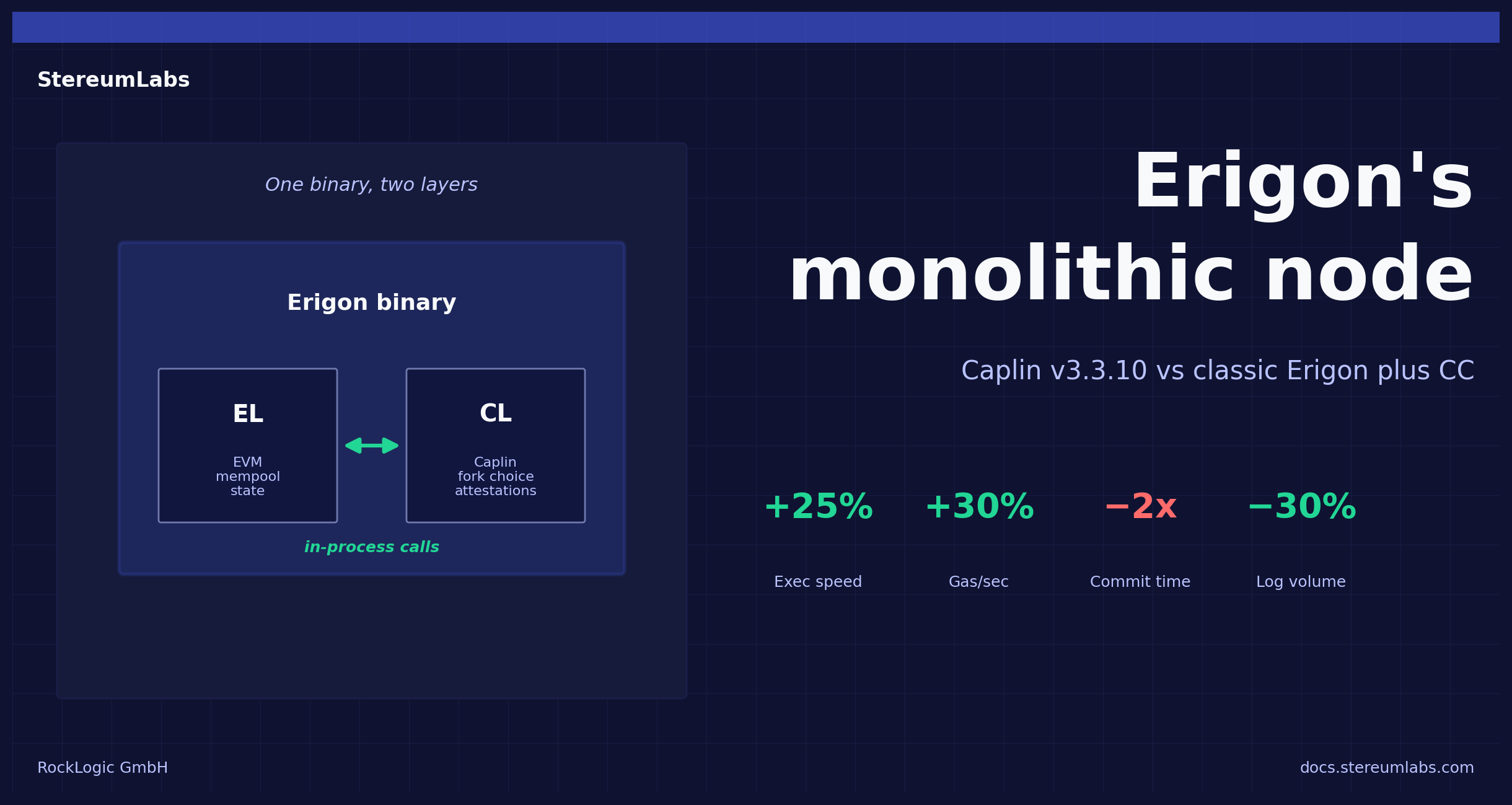
Erigon's monolithic node: 25% faster execution, 2x slower commits

Before The Merge in September 2022, an Ethereum node was a single Proof-of-Work client. Geth, Parity, Erigon, Nethermind, or Besu, each handling everything from networking and the EVM to mining and chain selection inside one binary. The Merge split that role in two: an execution layer (EL) for the EVM, transactions, mempool, and world state, and a consensus layer (CL) for Proof-of-Stake fork choice, finality, attestations, and block proposals. The two halves talk to each other over the engine API, a JSON-RPC channel authenticated with a JWT secret.
Most operators run those two layers as two separate binaries that talk over the engine API. Caplin v3.3.10 collapses them back into a single Erigon binary. We added a Caplin standalone host to the StereumLabs fleet on April 8, 2026, and let it run alongside the classic Erigon plus CC pairings under identical mainnet conditions. This post reports what we measured: where the monolithic architecture wins, where it pays a tax, and where it leaves observability holes.